With results that contrast with provincial and national observations, the Québec City CMA is not immune to the economic cycle. Rather, it is going through a more challenging period, underpinned by a particularly strong economy. – Carl Viel, President and CEO, Québec International
Highlights – April 2026
Are we in a geographic “bubble”?
The very low unemployment rate in the Québec City region is no longer simply an indicator of economic strength. In a full-employment market, each incremental increase in demand is limited by one clear factor—insufficient labour. The demand exceeds production capacity, which results in a significant tightening of the labour market, pushing indicators beyond sustainable levels in the long term and highlighting the importance of productivity gains.
This raises the question of whether the region might be in a geographic “bubble.” Despite contrasting metrics compared to provincial and national observations, the region does not exist in a vacuum and remains exposed to cyclical conditions. Nevertheless, the labour market’s strong diversification combined with major investment projects contribute to supporting the resilience of its economic fabric.
Analysis
Labour shortages persist despite the ongoing catch-up
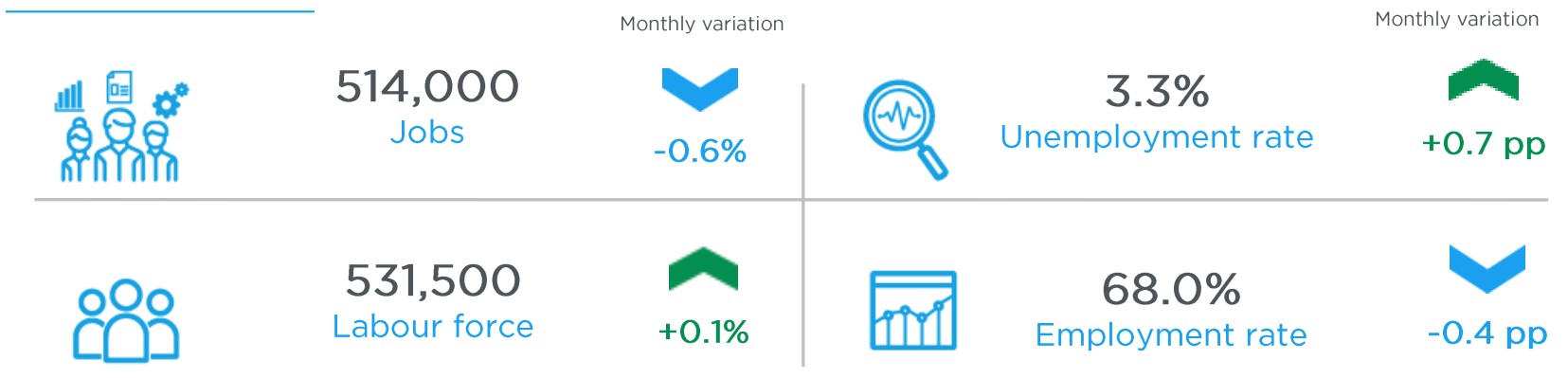
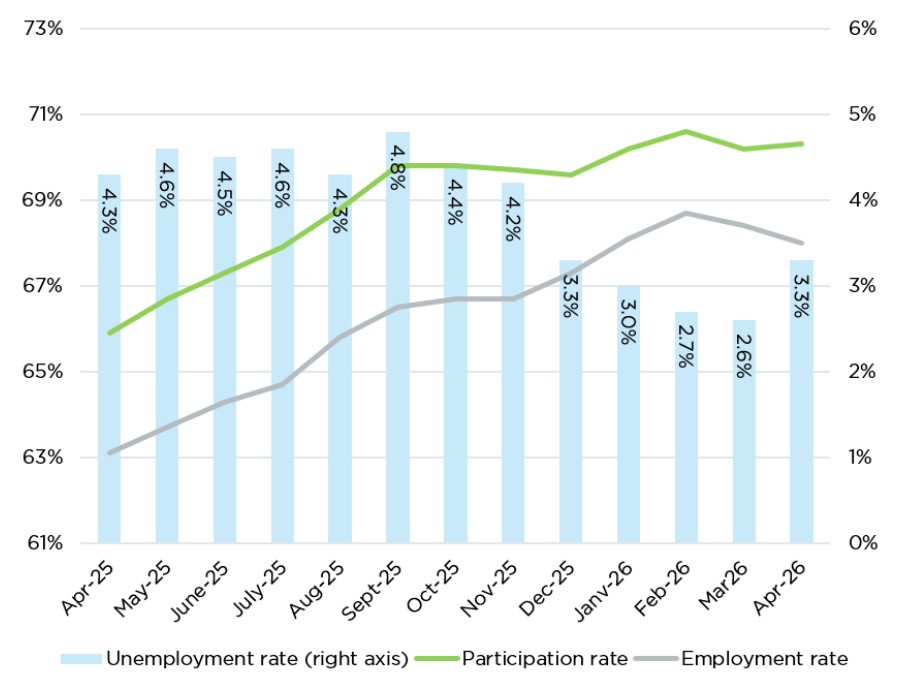
Based on Statistics Canada’s Labour Force Survey (LFS), the Québec City CMA’s labour market experienced a slight slowdown in April 2026, with the unemployment rate rising by 0.7 pp to 3.3%. However, this level remains below the full-employment threshold for the fifth month in a row, confirming acute labour shortages. This situation is reflected in the employment rate, standing at 68.0%, once again the highest in Canada, ahead of Calgary (67.2%). For comparison, Montréal recorded an employment rate of 61.7%, ranking 27th among Canadian CMAs.
With the number of jobs falling to 514,000 (-0.6%) and the labour force reaching 531,500 people (+0.1%), this slowdown in job creation is not yet sufficient to ease the pressure. Indeed, labour supply continues to gradually catch up to the excess demand accrued in recent months, maintaining the labour market in a persistent state of scarcity.
Unemployment rate comparison among major Canadian CMAs and the province of Quebec
 Source: Statistics Canada, Table 14-10-0459-01, and Québec International.
Despite the labour market remaining tight, there was a sharp increase in the unemployment rate of those aged 15–24 years old (6.9%). Progressing 2.2 pp, this metric reveals heightened sensitivity to economic conditions, as well as the effects of the strong labour force increase on that age group. – Rosalie Forgues
Data visualization
Evolution of the key employment indicators over one year
 Sources: Statistics Canada, Table 14-10-0459-01, and Québec International.
Persistent labour shortages despite unemployment increase
The April 28 federal economic update is in line with this reality. By focusing on skilled trades training, the “Team Canada Strong” measure is explicitly trying to alleviate this constraint. It implicitly recognizes that the main obstacle to growth, in several regions like Québec City, is no longer tied to short-term economic conditions, but indeed linked to labour shortages.
Rosalie Forgues
Economist
Québec International