“In a context where available talent is in short supply and does not match the positions that need to be filled, it is essential for businesses to consider digital transformation and automation.”
– Carl Viel, President and CEO, Québec International
Highlights – February 2026
Scarce specialized talent: An obstacle to business productivity
As the region undergoes major transitions, businesses are facing an increasing scarcity of specialized skills, a factor of production that, in several fields, cannot be substituted in the short term. This pressure on skilled talent acts as an economic bottleneck, limiting marginal productivity of capital and hindering organizations’ capacity to modernize their processes or diversify.
With the unemployment rate remaining below the full-employment threshold, key positions are likely to multiply without a corresponding increase in the pool of skilled workers. As a result, businesses may have to deal with longer recruitment timelines, intensified competition among employers and growing pressure on the conditions they offer. These tensions directly hamper the implementation of investment or modernization projects, which are nevertheless essential to playing a countercyclical role in the current economic environment.
Analysis
An unemployment rate indicative of a potential talent shortage
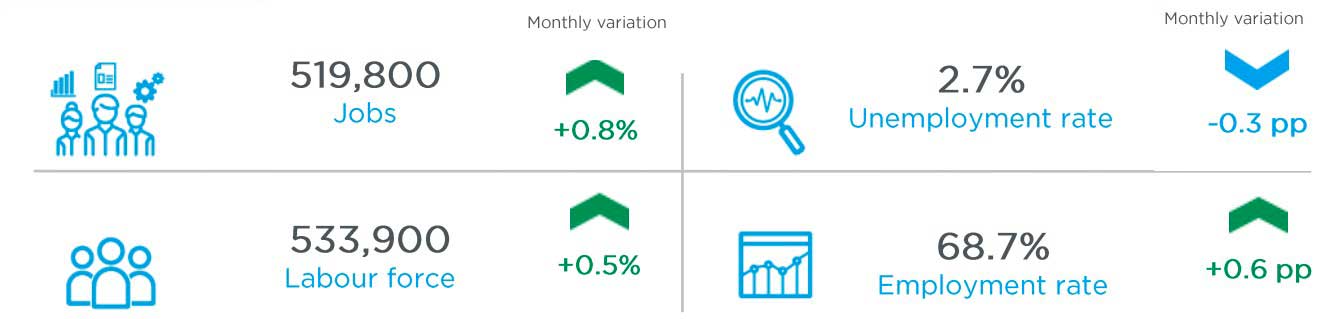
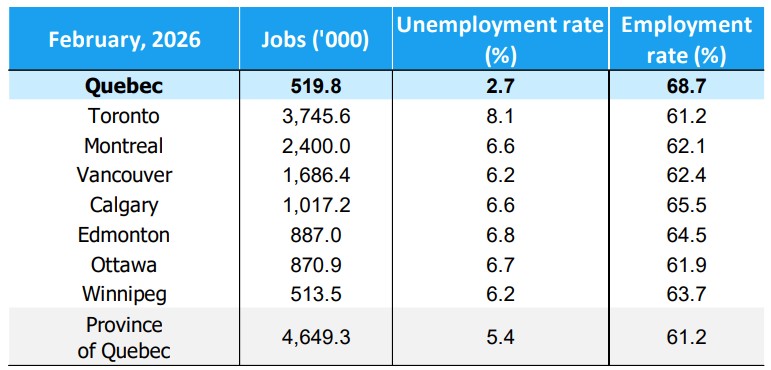
The unemployment rate in the Québec City CMA once again drew attention by reaching a historic low in February 2026, according to Statistics Canada’s Labour Force Survey (LFS). Now standing at 2.7% ( 0.3 percentage points [pp]), it is below the full-employment threshold for the third consecutive month. The high employment rate also reflects the labour shortage. At 68.7%, it is among the highest levels of the past decade and the highest in Canada.
These indicators point to an expanding labour market. Employment increased to 519,800 jobs (+0.8%), while the labour force grew by 0.5%, reaching 533,900 people. This dual trend reflects strong momentum, but also conditions in which pressure on businesses persists.
Understanding sub-markets for better recruitment planning
Although employment and the labour force are both growing, the region is facing excess demand for labour. However, concerns about labour shortages do not affect all sectors equally, as constraints vary significantly, shaping the regional labour market into multiple sub-markets.
“Although the ideal is to plan labour needs three to five years in advance, market realities make this difficult, creating a context in which planned recruitment—first locally, then internationally if necessary—becomes essential to secure key skills.”
– Rosalie Forgues
Data visualization
Evolution of the key employment indicators over one year
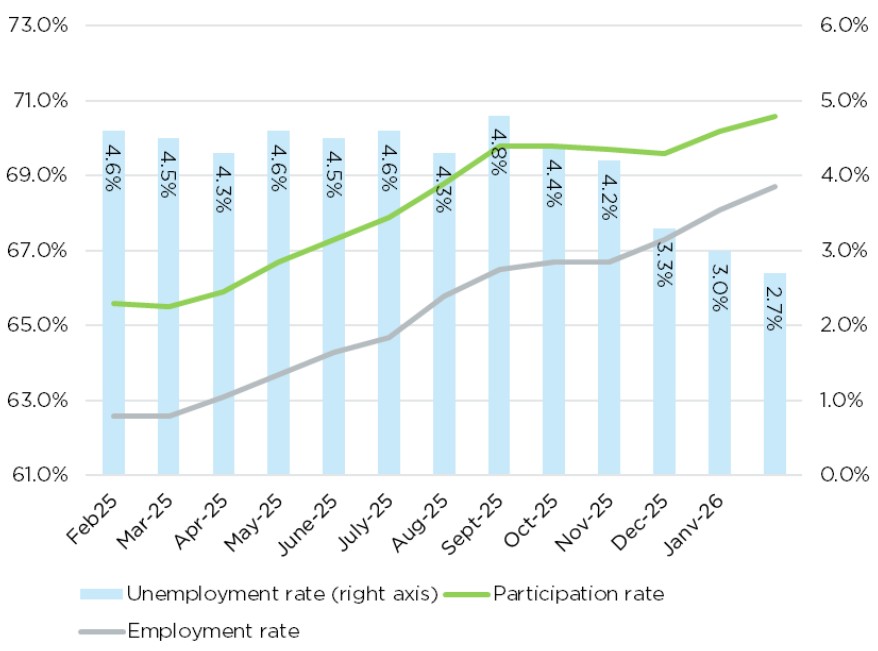 Sources: Statistics Canada, Table 14-10-0459-01, and Québec International.
Overview of employment in major Canadian regions
Rosalie Forgues
Economist
Québec International