At a glance
1. The drop in job vacancies reflects a gradual rebalancing of the labour market, while payroll employment remains high.
2. The decline in job vacancies masks contrasting realities: although recruitment needs are easing amid economic uncertainty, labour shortages persist in several key sectors of the region’s economy.
“The decline in vacant positions shows a progressive return to a more balanced labour market. Although hiring intentions are slowing down in the more uncertain economic context, recruitment challenges persist in several key sectors that support our region’s growth.” – Carl Viel, President and CEO, Québec International
Highlights – Second quarter of 2026
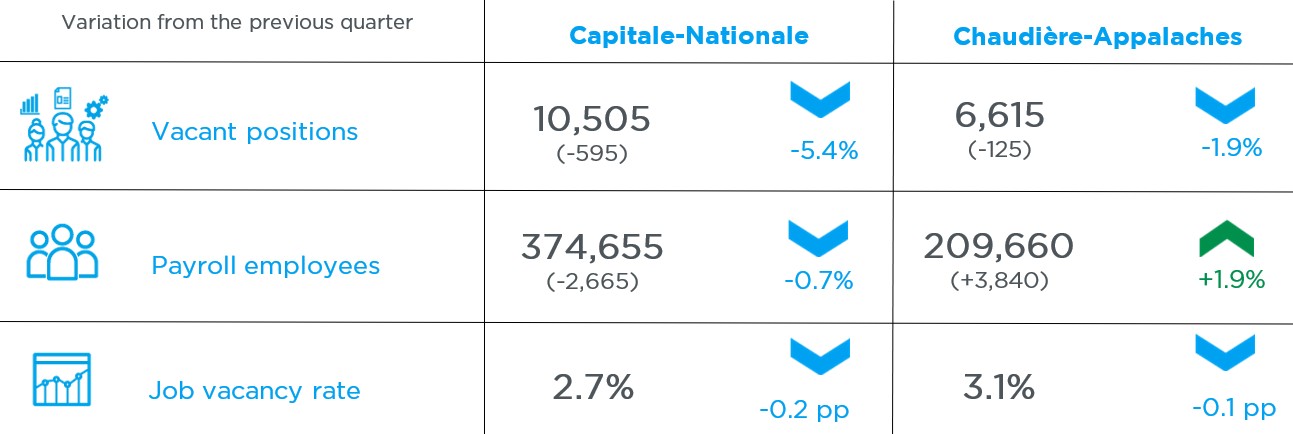
What about hiring?
Ratio du nombre de chômeur(s) / poste vacant | Comparatif de l’évolution des salaires |
Le ratio est en hausse entre le T1 2026 (≈0,78) et le T2 2026 (≈1,29). | Capitale-Nationale : « 28,25 $/h (-1,22 %) Chaudière-Appalaches : 26,90 $/h (-1,28 %) |
L’augmentation du ratio suggère que les occasions d'emploi diminuent par rapport au nombre de personnes à la recherche d'un emploi. | Sur un an, les salaires ont enregistré des variations asymétriques au sein de chaque région, notamment attribuables à l’incertitude persistante. Malgré la baisse enregistrée au second trimestre de 2026, des données supplémentaires seront requises afin de valider la tendance de long terme. |
Analysis
Short-term labour demand slows down in the second quarter of 2026
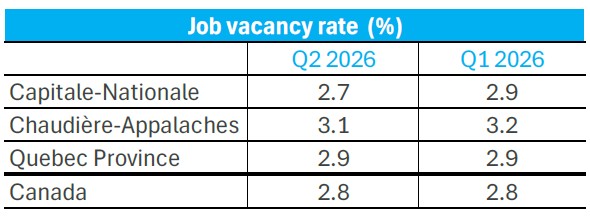
According to Statistics Canada’s Job Vacancy and Wage Survey (JVWS), the number of job vacancies stands at 10,505 in the Capitale-Nationale region and 6,615 in Chaudière-Appalaches, down 5.4% and 1.9% from the first quarter of 2026, respectively. Despite this decline, the job vacancy rate remains higher in Chaudière-Appalaches (3.1%) than in Capitale-Nationale (2.7%), a sign that tensions in the labour market remain greater in Chaudière-Appalaches. This decrease coincided with a decrease in payroll employment in Capitale-Nationale, suggesting some moderation in labour demand compared to the beginning of the year.
A sectoral analysis remains essential, as several sectors, including manufacturing and construction, continue to deal with significant labour constraints that may hinder production capacity and lead to bottlenecks in recruiting workers with key skills. Moreover, in a context marked by economic and business uncertainty, many employers may have adopted a more cautious approach to investment and recruitment, thus contributing to the drop in job vacancies.
Vacant positions as a leading indicator of economic activity
The decrease in the number of vacant positions suggests some moderation in hiring intentions. Because recruitment needs tend to respond to economic changes before employment does, vacant positions are a leading indicator of economic activity and labour-market conditions. Therefore, the decline in job vacancies points to a gradual easing of pressure on labour demand, suggesting a normalization of labour-market conditions rather than a marked economic deterioration. This interpretation is consistent with the latest Labour Force Survey.
“The decline in vacant positions shows a gradual shift toward greater caution in hiring, a trend that could accelerate in the third quarter of 2026. However, this normalization of labour demand does not erase recruitment challenges in several strategic sectors where wages remain a lever to attract and retain talent.” – Rosalie Forgues, Senior Economist
Data visualization
Graph 1. Evolution of cumulative job vacancies in the combined regions of Capitale-Nationale and Chaudière-Appalaches
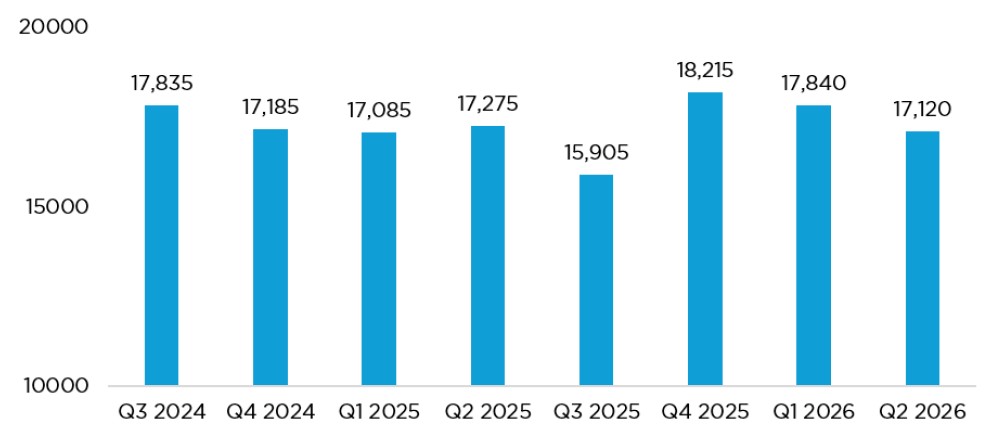 Sources: Statistics Canada, Table 14-10-0398-01, and Québec International.
Table 1. Job vacancy rate by region
What is considered a vacant position?
According to the JVWS, a job is considered vacant if it meets these three conditions:
• It is vacant on the first day of the month, or will become vacant during the month.
• There are tasks to be carried out during the month for the job in question, so it is not a frozen or suspended position.
• The employer is actively recruiting outside the organization to fill the job.
Rosalie Forgues
Senior Economiste
Québec International