Highlights – September 2025

Data visualization
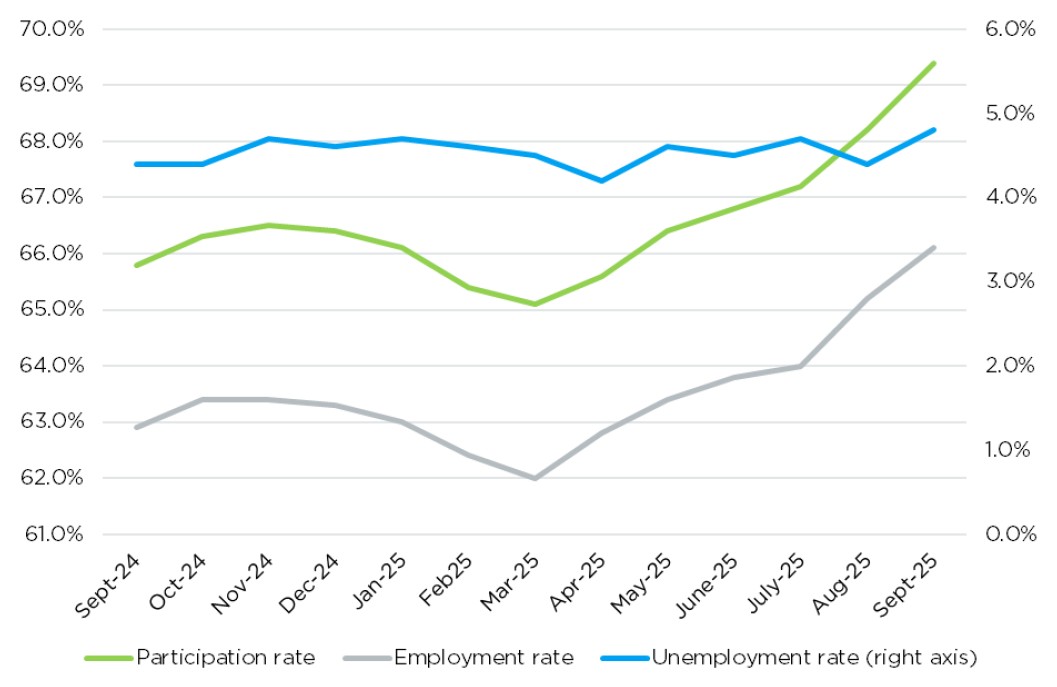
Evolution of the key employment indicators over one year
 Sources: Statistics Canada, Table 14-10-0459-01, and Québec International.
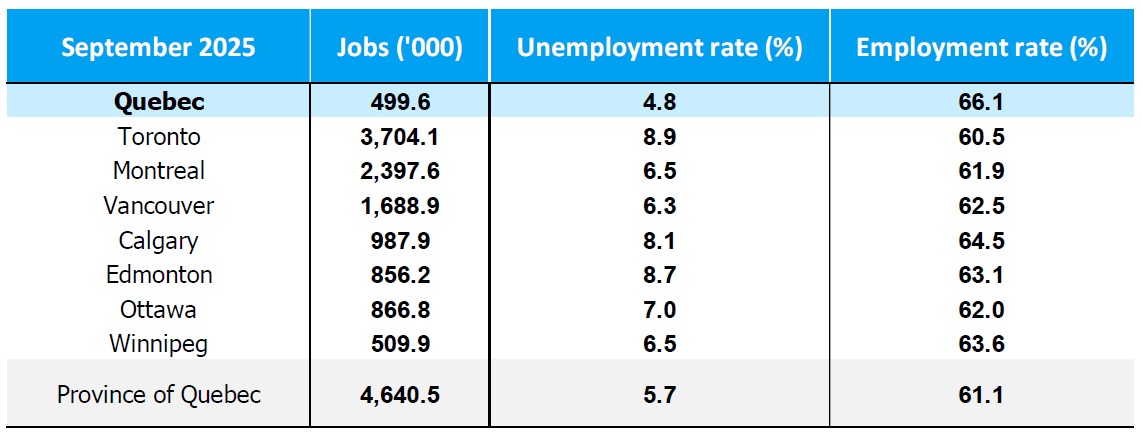
Overview of employment in major Canadian regions
Analysis
Peak in employment despite uncertainty
According to Statistics Canada’s Labour Force Survey (LFS), employment in the Québec City CMA recorded its sixth consecutive increase in September, reaching 499,600 jobs (+1.4%). Despite the ongoing uncertainty, this is a historic high. This evolution is supported in part by the growing labour force (+1.8%), which has now reached 524,700 people. Moreover, Québec City has maintained the lowest unemployment rate among the eight major Canadian CMAs (4.8%, +0.4 pp), placing it in second rank in the country, tied with Victoria. In this context, the employment rate has reached 66.1% (+0.9 pp).
At the Canadian and provincial levels, the labour market once again remained relatively stable. In both cases, employment remained virtually unchanged, with a variation below one tenth of one percent. The unemployment rate also registered modest fluctuations, reaching 7.0% in Canada (+0.1 pp) and 5.7% in the province of Quebec (-0.2 pp). The apparent stability in these indicators points to the ever-fragile balance between labour force growth and the pace of job creation.
Between labour needs and caution
Labour market dynamics remain contrasted in the region, with demographic pressures and structural transformations affecting each sector differently. While some sectors face labour shortages, others stagnate or contract.
In some cases, the current economic uncertainty, intensified by trade tensions, slows down hiring decisions in some sectors, as businesses hesitate to recruit in case demand drops or instability persists. In other cases, labour scarcity, in part due to the aging workforce and shifting work preferences, exerts growing pressure on the market. This imbalance between job supply and demand becomes an obstacle for some businesses.
In this context, the transportation and warehousing sector (+9.9%) and utilities (+7.7%) registered the highest monthly growth in employment, based on non-seasonally adjusted data. On the other side of the spectrum, the information, culture and leisure (-10.7%) and manufacturing (-7.1%) sectors registered the strongest declines. On an annual basis, the construction industry (+36.9%) and finance, insurance, real estate, rental and leasing (+28.5%) stood out with the strongest growth, while professional, scientific and technical services (+22.9%) and manufacturing (-11.6%) had the largest declines.
Rosalie Forgues
Economist
Québec International