Highlights – October 2025
Data visualization
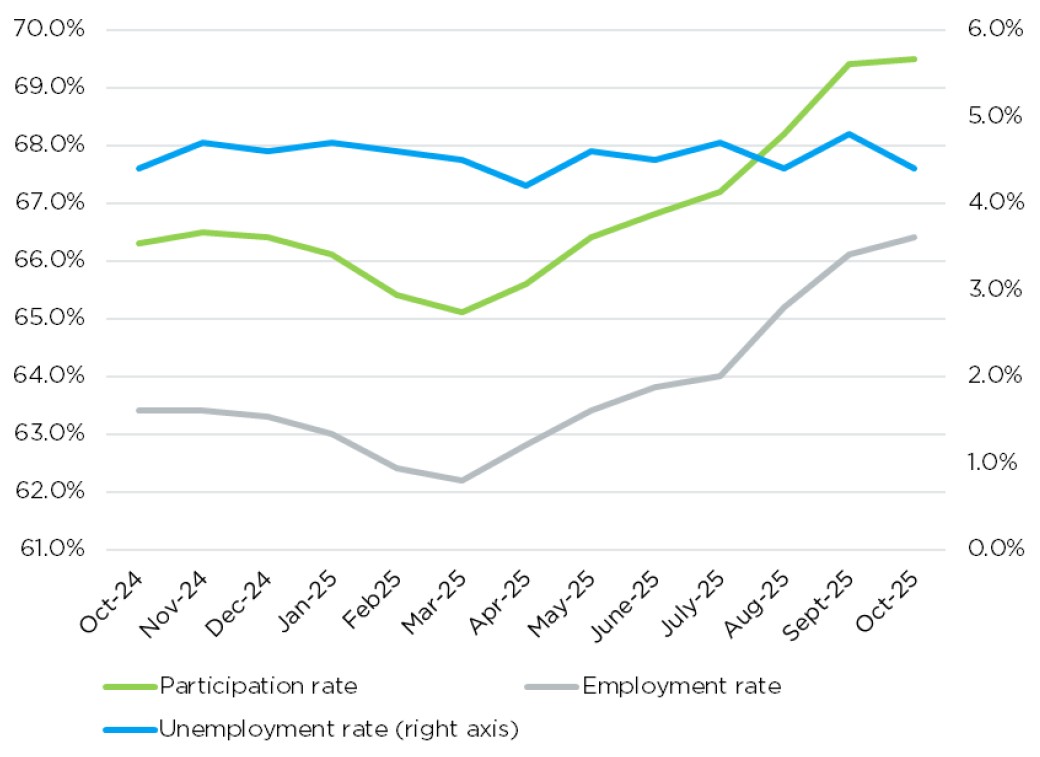
Evolution of the key employment indicators over one year
 Sources: Statistics Canada, Table 14-10-0459-01, and Québec International.
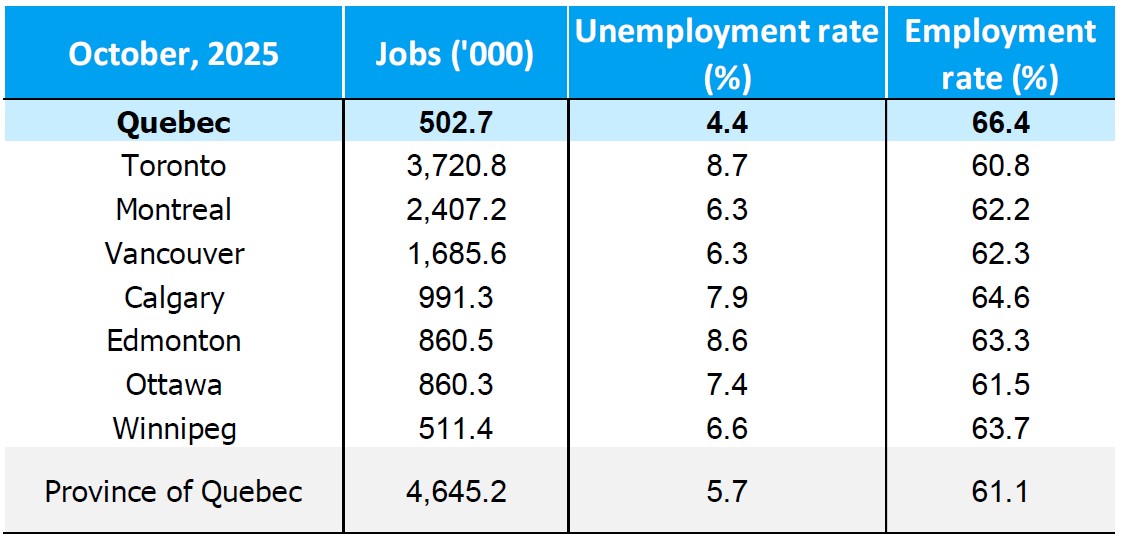
Overview of employment in major Canadian regions
Analysis
Steady growth in Québec City, stability across the country
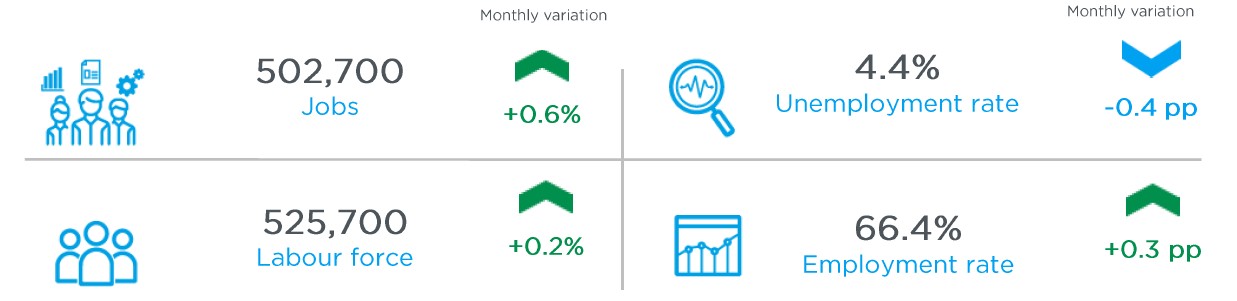
According to Statistics Canada’s Labour Force Survey (LFS), the labour market is starting the last quarter of 2025 on a positive note, marking a net gain of 3,100 jobs compared to September, bringing the total number of people employed to 502,700. In this context, the region maintains a favourable position with regard to unemployment, ranking second among all Canadian CMAs, behind Trois-Rivières and Victoria, which both registered a 4.2% unemployment rate. Moreover, Québec City ranked first among the eight largest urban centres for that indicator.
Other labour market indicators also reflect this relative resilience. Employment in the Québec City CMA grew by 0.3 pp, settling at 66.4%, while the labour force continued to grow, with a 0.2% increase, bringing the total to 525,700 individuals. These adjustments could reflect a moderate expansion of the region’s labour market in October, yet it is too soon to confirm whether this trend will continue, or if these are simply the result of seasonality and temporary sectoral rebalancing.
Stagnation in the province of Quebec and Canada, but a distinct regional reality
Across the province and Canada, trends show a period of relative stability. The unemployment rates remained unchanged, at 5.7% in the province of Quebec and 7.0% in Canada. However, employment registered a positive variation of +0.1% in both the province and Canada. Although modest, this progression reflects relatively strong labour market conditions outside of the Québec City CMA.
The LFS also revealed that, among the 20 main CMAs, there was a concentration of financial challenges in the south of Ontario, where unemployment rates exceed the national average. For example, in Oshawa, 37% of respondents lived in a household experiencing financial difficulties. Conversely, this percentage drops when it comes to regions with a lower unemployment rate, with Québec City standing out with the lowest proportion in Canada (20%).
Federal budget and immigration: upcoming effects on the labour market
The federal budget and the revision of provincial immigration thresholds were announced earlier this week. Overall, Canada’s labour market could be impacted by the restraint measures and targeted investments, as well as the reduction of temporary and permanent immigrant admissions in parallel with the increase in economic immigration. These budget and demographic adjustments could generate contrasting effects, which we will be monitoring over the coming months.
Rosalie Forgues
Économiste
Québec International