Highlights – January 2026
Data visualization
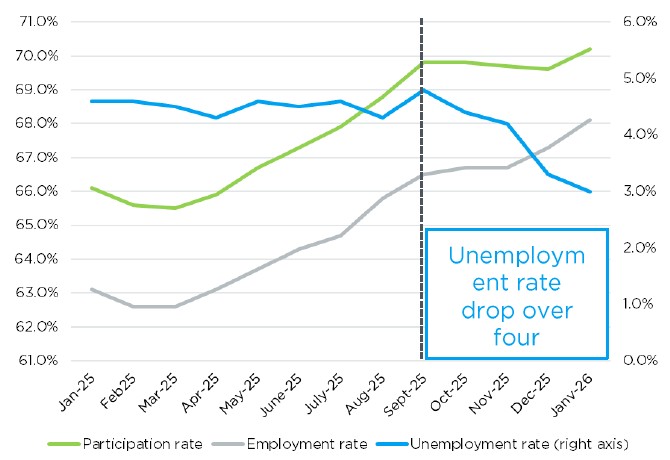
Evolution of the key employment indicators over one year
 Sources: Statistics Canada, Table 14-10-0459-01, and Québec International.
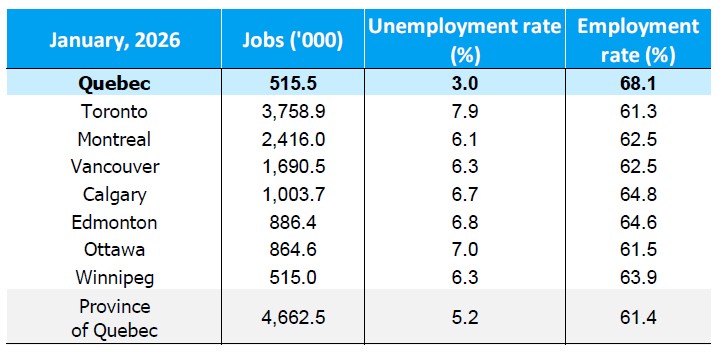
Overview of employment in major Canadian regions
Analysis
Below the full-employment threshold at the beginning of the year
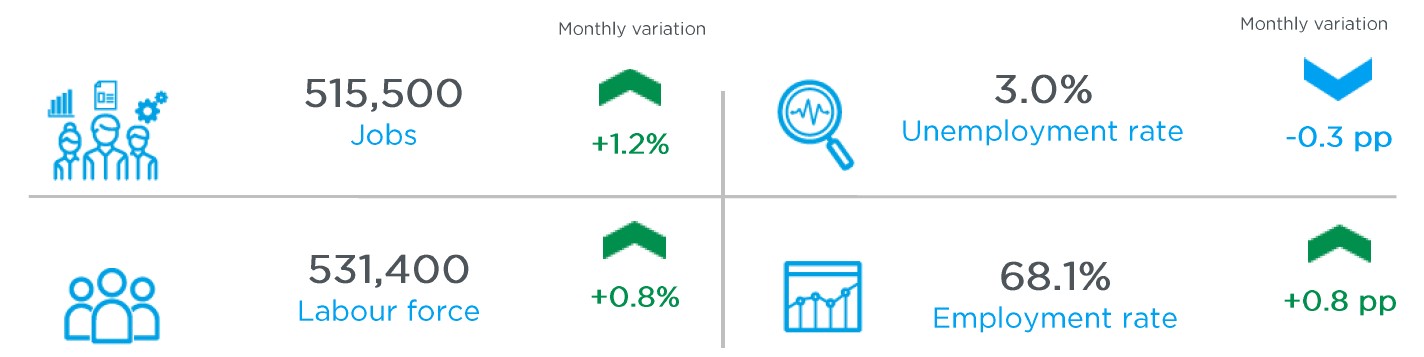
According to Statistics Canada’s Labour Force Survey (FLS), the labour market tightened significantly in January 2026 in the Québec City CMA, as employment increased to 515,500 jobs (+1.2 percentage points [pp]) and the labour force grew 0.8%, reaching 531,400 people. However, the unemployment rate settled at 3.0%, sparking particular interest as it has remained below the full-employment threshold for two consecutive months. Meanwhile, the employment rate grew to 68.1%, the highest level since 2019 and one of the highest in the past decade.
In the context of this tightening, it is important to note that a very low unemployment rate can present some risks. Indeed, as the workforce becomes scarcer, businesses may delay their recruitment and investment decisions due to insufficient capacity to fill key positions. Furthermore, this situation is not consistent across all industrial sectors, revealing a highly heterogeneous labour force in the region.
Additionally, a high employment growth rate can contribute to inflationary pressures, prompting businesses to increase wages, which in turn would lead to increased prices. This heightened tension could cause labour shortages, slow down projects and increase production costs, weakening the competitiveness of those sectors that are especially exposed to international competition. The region has not reached a critical point, but the current tightening of the labour market requires more vigilance, because an overheating economy can become an obstacle to its own growth.
A first in 5 years: young people below the full-employment threshold in a competitive market
At the beginning of the year, the challenge is not to figure out whether young people are working in the Québec City region, but rather to analyze their insertion patterns in an increasingly competitive market and assess what this dynamic reveals about the economy’s absorptive capacity. Based on non-seasonally adjusted data, the unemployment rate for those aged 15 to 24 was 3.2% (-6.5 pp year over year), below the full-employment threshold for the first time in five years.
A separate conversation is relevant with regard to the replacement of departures. The Conjoncture 2026 survey reveals that the proportion of managers who anticipate an increase in personnel in their businesses was 54% in 2026, compared to 62% in 2025. In this context, two facts stand out: some departures are not targeted for replacement, and recruitment challenges persist (73%).
This shows that although the labour market maintains its absorptive capacity, it is now focused on stabilization, production increase and skill building. Therefore, young people have to integrate into a competitive labour market. The next few months will reveal whether the low unemployment rate among those aged 15 to 24 persists in a context where hiring is dropping in key sectors.
Rosalie Forgues
Economist
Québec International